When we think about nutrition in the early years, it is easy to place emphasis on what children are eating, whether the menu is balanced, whether children are getting enough fruit and vegetables, or whether meals provide the nutrients they need to grow. But there is another equally important area of focus: how do mealtimes make children feel?
For early years educators, mealtimes are much more than an opportunity to fill hungry tummies. They are a valuable part of the early years day, providing opportunities for children to develop their independence, communication, social skills, explore and become familiar with new and unfamiliar foods, and build confidence and enjoyment around eating.
The early years is a particularly important time for developing feeding behaviours and food preferences. Food may be offered several times a day in an early years setting and, for some children, it may be where they experience certain foods for the first time, or where they have the opportunity to eat alongside their peers. Educators therefore have a unique opportunity to help children develop a positive association with food.
So, what can early years educators do to make mealtimes a positive part of the day?
(1) Create a calm and comfortable environment
Learning to eat is a complex sensory and developmental task. Children need to feel secure, comfortable and calm before they are ready to engage with food.
Start by considering the mealtime environment. Are children sitting securely and comfortably? Are tables and chairs appropriate for their size? Are their feet supported, either firmly on the ground or resting on a footrest? Can they comfortably reach their food and use their cutlery?
A stable and supportive seating position can support concentration, comfort and control, while reducing fidgeting and postural fatigue. When children feel physically secure, they are better able to focus on the task of eating and exploring food.
It is also worth thinking about how you can make the mealtime environment feel warm, welcoming and distinct from the rest of the day. Simple touches such as tablecloths, paper flowers, napkins or seasonal decorations can help transform a table into an inviting place to eat. These small details don’t need to be elaborate or expensive. The aim is to create a clear transition from play and other activities into a more relaxed, social mealtime. Creating a sense of occasion can help children recognise that mealtimes are an important and enjoyable part of their day.
Think about distractions too. Clearing away toys and activities before mealtimes can help children focus on the social and sensory experience of eating. Mealtimes don’t need to be silent, but they should feel purposeful and calm rather than chaotic.
(2) Give children opportunities to be independent
Mealtimes are a brilliant opportunity to build children’s independence. Where developmentally appropriate, encourage children to help with the mealtime set-up, pour their own water, serve themselves, and practise using cutlery. It might be slower and messier initially but that’s all part of the learning process.
The goal isn’t simply to get food from the plate into the child’s mouth as efficiently as possible. It is to help children develop the skills and confidence they need to feed themselves. Make sure utensils, cups and serving equipment are appropriate for the child’s developmental stage. If equipment is too difficult to use, children can quickly become frustrated or feel that they are not capable. When eating feels difficult or uncomfortable it creates barriers to food acceptance and enjoyment.
(3) Take the pressure out of trying new foods
It can be tempting to encourage a reluctant eater to “just try it”. But pressure rarely creates a positive association with food. Instead, think about exposure rather than expectation.
Children often need to see and experience foods many times before they feel ready to explore or try a food. Repeated exposure can help increase familiarity and acceptance, so a food that is rejected today can simply be offered again another time.
And remember, eating isn’t the only form of exposure. A child might first tolerate a new food being on the table, then interact with it using a spoon, fork or other utensil, before progressing to touching, smelling, licking and eventually tasting it. Each of these is an important sensory step in learning about food. Success with a new food isn’t measured by whether a child eats it or not. Instead, meet the child where they are and recognise that some foods, flavours and textures will take longer to explore and become confident with than others.
Food exploration doesn’t have to happen at mealtimes either. Cooking, gardening, messy play, role play, arts and crafts, or simply talking about and looking at different foods can all provide enjoyable, low-pressure opportunities for children to interact with food and build familiarity.
(4) Language matters
Children are highly attuned to the adults around them and pick up on even the smallest communication cues. From our facial expressions and body language to a raised eyebrow, a screwed-up nose or a change in tone of voice. Even when we think we are not saying anything, our reactions can communicate how we feel about a food and can influence how a child perceives it.
Comments such as “Why don’ you just try it?”, “But I know you eat this at home” or “Well done! You’re such a good eater” can add unhelpful pressure to eat and influence how children think about themselves and food.
Instead, use neutral, factual and curious language.
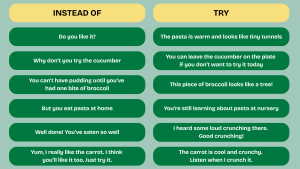
This keeps the focus away from coercion to try or pleasing the adult and more towards playful facts about food with no pressure to try. This creates space for building curiosity about food at a pace that suits the child and supports a more positive relationship with food.
(5) Remember that the mealtime experience matters as much as the menu
A beautifully planned, nutritionally balanced menu is important, but it doesn’t automatically create positive eating experiences. The environment in which food is served, the language adults use, the opportunities children have to be independent, and the level of pressure they experience can all influence how they engage with food.
For early years settings, this means that every mealtime is an opportunity for learning. It is an opportunity to practise using a spoon, pour a drink, recognise hunger and fullness, try something unfamiliar, develop vocabulary, learn where a food comes from, talk to friends, explore sensory experiences and simply enjoy sitting together.
The aim isn’t for every child to clear their plate or try every food offered. The aim is to create an environment where children feel safe, capable and confident around food, where they can explore without pressure, develop their skills and gradually build the foundations for a positive relationship with eating.
Because ultimately, excellent early years nutrition isn’t just about serving nutritious food. It’s about creating an approach and environment that help children learn to enjoy it.
Author: Catherine Lippe, Head of Nutrition and Policy for Nursery Kitchen